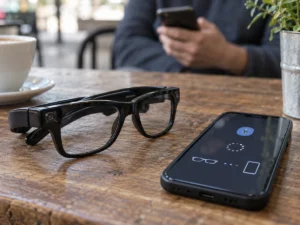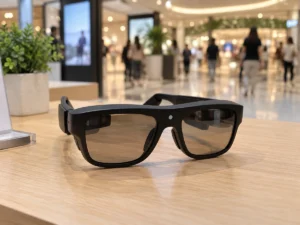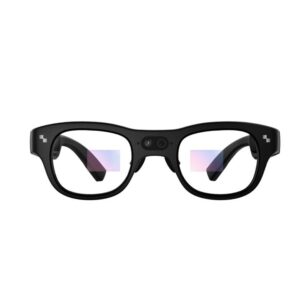

Owning camera glasses in the Netherlands is legal, and so is wearing them. Filming the people around you is a different matter. On 22 September 2026 the Dutch data protection authority, the Autoriteit Persoonsgegevens (AP), published its reading of the smart glasses privacy rules, and it leaves owners little room. Outside your own home, recording with camera glasses is usually not allowed. The white recording light does not count as telling anyone. And footage of recognisable people cannot go on social media unless they agree. The AP is applying the GDPR, the same law in every EU country, so its reading reaches Ray-Ban Meta owners well beyond the Netherlands. A joint statement on smart glasses from the EU’s board of privacy regulators is expected this autumn.
What you may still record
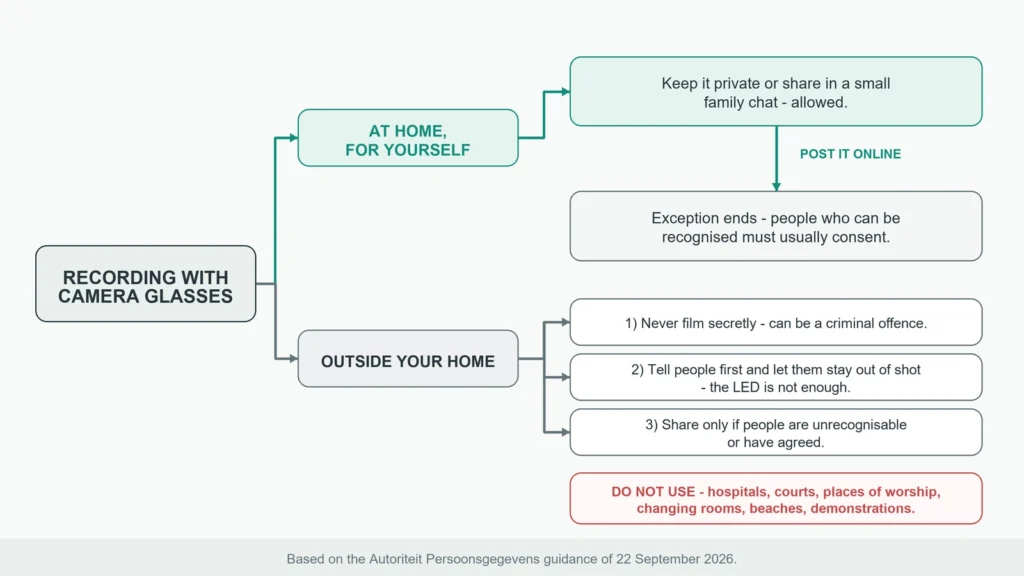
The clear exception is recording for yourself. A video of a birthday party at home falls outside the privacy law, as long as the footage stays private or goes to a very small circle. The AP’s own example of a small circle is a family group chat. Post the same clip on Instagram and the exception no longer applies, and the people who can be recognised in it usually have to consent.
Outside the home the regulator sets out four rules for glasses. Secret filming is out, and the AP says it can be a criminal offence. People have to be told you want to film them and given a chance to stay out of the shot. Footage can be shared only when the people in it are unrecognisable in the background, or when the people in focus have agreed. And you should not use the camera where people expect more privacy, such as changing rooms, hospitals and courts, or where filming is sensitive, such as a beach or a demonstration.
The AP sums this up in one line that most owners will not have seen in any shop: usually, you may not make recordings with your camera glasses outside your home. It adds that in public space it is almost impossible to ask every passer-by for permission.
Why the recording light does not count
Every Ray-Ban Meta frame has a white LED on the front that lights up while the camera records. Meta presents it as its answer to privacy concerns. The AP says the light is not enough to inform people, because you still have to tell them and let them step aside.
The Dutch consumer association, the Consumentenbond, published a test of that light on 10 September. Meta’s own page, as the association quotes it, says the camera switches off automatically if the glasses detect that the LED has been covered, tampered with or destroyed. A plain sticker did block recording. Stickers sold online for a few euros, opaque at the front but letting light in at the sides, did not. The association’s Ray-Ban Meta Wayfarer, a €500 model with a 12-megapixel camera, kept filming with one fitted. It last checked on 2 September, on software version 127. The testers also found the light hard to see in full sun, especially from a distance.
None of that changes what an honest owner has to do. It does explain why the regulator refuses to treat the light as notice, and why it tells manufacturers to make camera and AI activity clearly visible and to prevent tampering with that signal.
The assistant counts as well
The AP’s notice goes beyond photos and video. Glasses that respond to voice commands or hand gestures have to listen, and in some cases watch, all the time to catch them. When you ask the assistant about what you are looking at, frames from the camera and sound from the microphones can be processed to answer you. In the regulator’s words, personal data can be processed with these AI features even when no photo or video is saved.
In practice, a question to the assistant about the menu in a busy café can send a frame that includes the people at the next table. Nothing appears in your gallery, and the rules still apply to them.
Where you should expect to be asked to take them off
The regulator advises owners and managers of hospitals, courts and religious buildings to ban both wearing and using camera glasses in their house rules. It asks employers to ban them at work as far as possible, to protect trade secrets and the privacy of staff and customers, and it says employers may not use the glasses to monitor workers. Venues are already moving. The Consumentenbond names the Utrecht music centre TivoliVredenburg, which bans camera glasses in its house rules, and says more music venues, theatres, bars and restaurants are doing the same.
For anyone who wears prescription lenses in their smart glasses, this is the part that bites. A ban on wearing means taking off the glasses you see with. The AP goes further than any maker would. It advises against using camera glasses as your everyday glasses, with or without a prescription, and tells owners to keep an ordinary pair of prescription glasses at hand.
That advice lands as the choice in Europe grows. Meta’s Ray-Ban Display glasses reach shops in France, Italy and Germany on 13 October, and they carry a camera too.
A national ban is not coming yet
The Dutch parliament wants more. According to the trade site Computable, citing the public broadcaster NOS, a majority in the lower house wants a more explicit ban that covers more situations than the law does today. The government does not. State Secretary Claudia van Bruggen sees no need for a national ban, pointing to the privacy law and to criminal provisions that already forbid secret filming in places such as toilets and changing rooms. The cabinet is waiting for guidance from the European Data Protection Board.
The AP, for its part, says it is examining further measures against camera glasses and other wearables with a camera, and has started a review of the companies that sell AI wearables. Selling and owning the glasses remain legal. The Consumentenbond, which wants Meta’s current glasses banned, points out that the problem sits with how they are used.
The EU-wide statement matters most for readers outside the Netherlands. Other countries’ regulators apply the same law and may reach similar conclusions, and Snap, which plans to ship Specs in the UK and France this autumn, has already set out its own privacy commitments for Specs.
What to do if you own a pair
Keep recordings of other people for yourself or a small family chat. Ask before you film anyone, and turn away from people who say no. Post nothing in which a stranger can be recognised. In hospitals, courts, places of worship, changing rooms, on the beach and at demonstrations, leave the camera off or take the glasses off. If you rely on them for your prescription, carry a second pair.
For anyone who would rather not deal with any of this, Meta announced its first glasses without a camera on 23 September. Ray-Ban Meta Audio costs $349 in the US and ships there on 13 October. Meta has not said when it reaches Europe.
If someone has filmed you, the AP’s advice runs in order. Ask the person to delete the footage, ask the platform to remove it if it was posted, report it to the police in serious cases, and file a complaint with the AP if none of that works.