Google began rolling out blood pressure trends to the Pixel Watch 3, 4 and 5 on 24 September 2026, together with insulin resistance trends and a sleep breathing score. You set them up in the Google Health app this week, they cost nothing on those three watches, and the first monthly reports are due in early October. What arrives is not a Pixel Watch blood pressure reading. The watch estimates a trend from its pulse sensor across the month and tells you when that trend looks persistently high. Google files the whole feature as general wellness, with no medical clearance behind it. That label helps explain how it reached three generations of watch at once, and it is also the main limit on what the report can tell you.
What reaches the watch this week
The new tools share the name Health Guardian. Three of them are rolling out now on the Pixel Watch 3, 4 and 5: Blood Pressure Trends, Insulin Resistance Trends and Sleep Breathing Quality. Setup happens in the Google Health app on your phone, and none of them needs a subscription on those watches.
The Fitbit Air is treated differently. Google says Air owners will see blood pressure and insulin resistance trends “later this year”, and only with Google Health Premium, which costs $9.99 a month in the US. Google’s own post names those two features for the Air, not the sleep breathing score.
In Japan and Mexico the features carry other names, Vascular Stress and metabolic stress trends, so search the app for those if you live there. Google has not published a country list for the rest. Its footnote says only that availability “varies by region/country and device”.
One more tool sits in the same suite but is older and narrower. Breathing Emergency Detection works on the Pixel Watch 4 and 5 in some European countries, and prompts a call to emergency services when blood oxygen drops sharply. It carries a CE mark in the EU and has not been cleared or evaluated by the FDA.
How the watch estimates blood pressure without a cuff
The watch reads the shape and speed of your pulse through its optical sensor and combines that with motion data, day and night, including while you sleep. A Google model called WavesFM turns those waveforms into an estimate. There is no calibration step and no cuff to strap on first. Google says the method was validated against 24-hour ambulatory blood pressure monitoring, the clinic standard in which a cuff inflates automatically through a whole day and night.
That is a different design from the rings and watches that start from a cuff. Our piece on Circular Ring blood pressure and its cuff calibration shows the other approach, where you anchor the ring to real readings before it estimates anything. Google skips that step, and it also cannot take a reading on demand. You wait for the month to close.
On the first of each month the app delivers a summary. If the trend has stayed high, the summary suggests checking with a home blood pressure monitor or talking to a doctor. Google’s pages do not show whether the report includes estimated figures in mmHg or only a verdict on the trend.
Insulin resistance trends work on the same monthly rhythm. Google’s model reads heart rhythm, sleep and daily movement, and the company says the result was validated against fasting blood tests of glucose and insulin. It is not a glucose reading and not a diabetes check.
Wellness label or medical clearance
The footnote under Google’s announcement is blunt. The trends are “intended for general wellness and informational purposes only”. They are “not a prescreener for diabetes, hypertension, or sleep apnea”, they “should not be used to adjust medications”, and they are not for people who are pregnant.
Apple went the other way. Its hypertension notifications went through regulators, look at the optical heart sensor over 30-day periods, and are meant for adults aged 22 or over who have not been diagnosed with hypertension. After a notification, Apple asks you to log readings from a cuff for seven days. Because each new watch model needs its own clearance in each market, the Series 12 still waits for approval in 33 regions.
Presenting the trends as wellness information keeps the Pixel Watch out of that queue. So its report can nudge you, but Google does not claim it catches hypertension, and a quiet month does not mean your blood pressure is normal. With either watch, the number a doctor will use comes from a cuff.
When your first report can arrive
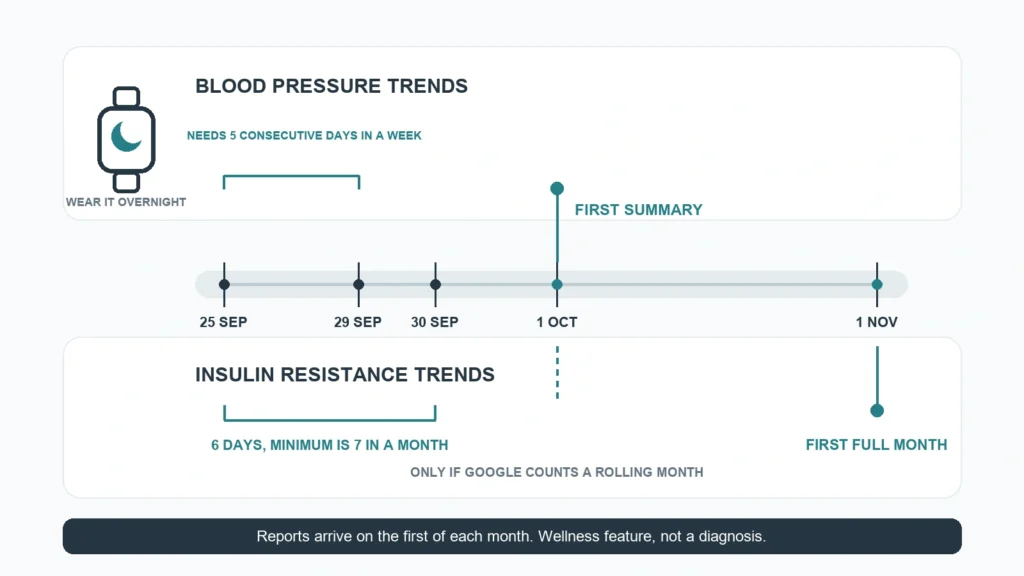
The small print sets two different thresholds, and both reports land on the first of the month. Blood pressure trends need at least five consecutive days of wear in a week, while insulin resistance trends need seven days somewhere in the month.
Take someone who switches the features on today, Friday 25 September, and wears the watch every day and night. By the end of Tuesday 29 September they have five consecutive days, enough for the blood pressure summary on 1 October. September then has six days left counting today, one short of the insulin minimum, if Google counts the calendar month. Google has not said whether it does. If it does, anyone starting now gets a blood pressure summary in October and a first insulin summary on 1 November.
The practical point is to wear the watch overnight from the first day. The blood pressure model reads your pulse during sleep too, and nights on the charger leave it less to work with.
Who should not rely on it
Pregnant readers are excluded by Google’s own terms. So, in practice, is anyone already treated for high blood pressure or diabetes, because Google says the trends should not guide medication. A home cuff, used the way your doctor suggests, stays the tool for that job.
For everyone else, treat a high trend as a reason to measure properly. A validated upper-arm monitor, used at the same times each day for a week, gives you figures a doctor can use.
What to do now
Open the Google Health app on the phone paired with your Pixel Watch 3, 4 or 5 and look for the Health Guardian setup this week. Wear the watch through the night until 1 October. If you own a Fitbit Air, nothing changes yet, and the trends will need Premium when they come.
Two things would change this advice. Google has not named the countries that get the blood pressure trends, and it has not shown what the monthly report looks like. The first reports on 1 October should settle the second.