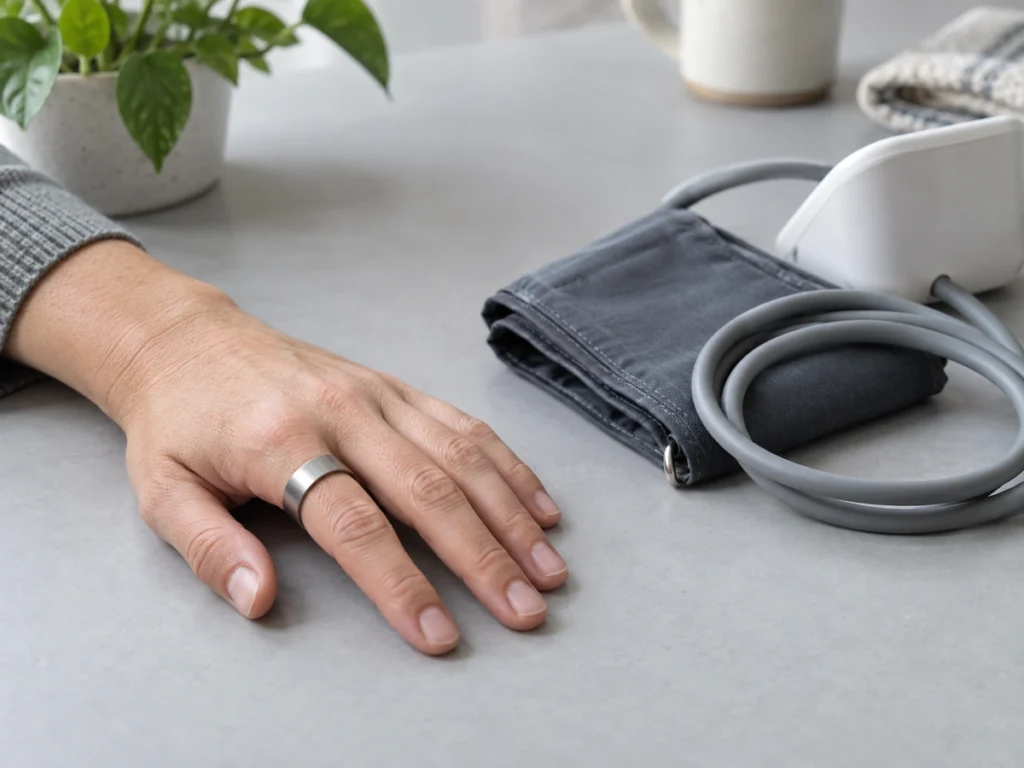
A ring that tells you your blood pressure sounds like the thing people have been waiting for. Circular started rolling exactly that out to every Ring 2 this month, on iOS and Android, in all markets. Before you read any headline about it, read one sentence from Circular’s own help text: “It does not replace a cuff and it is not a diagnosis.” That is the honest frame, and it comes from the company selling the ring.
What shipped, and when
Circular’s public release notes give two dates. App version 29.27.0, dated 2 September 2026, introduced the “Blood Pressure Circle: a new circle available now for compatible Gen 2 rings.” App version 29.28.6, dated 13 September 2026, added “a Blood Pressure calibration step: illustrated instructions for ring positioning” and fixed a bug where valid blood pressure results were being hidden behind a recalibration prompt.
Notice what those two entries tell you together. The feature arrived, and then eleven days later the company had to add illustrated instructions for how to position the ring. Placement matters more than a marketing page suggests.
Circular describes the result as the first smart ring to read blood pressure in seconds. That is the company’s claim about its own place in the market, and nobody independent has verified it.
How it works, in plain terms
The ring does not squeeze your arm, so it cannot measure pressure the way a cuff does. What it does instead is build a personal model.
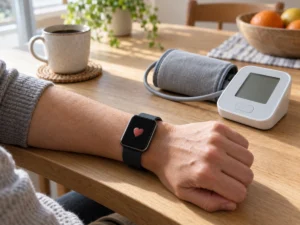
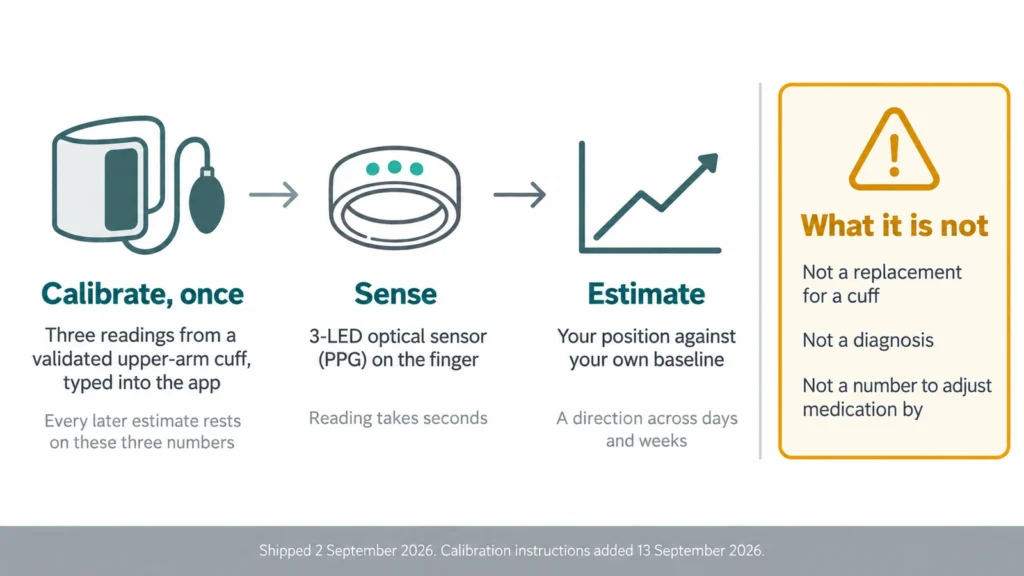
Circular’s own description of the setup is precise: “Enter three readings from a validated cuff so the app can anchor the model to you, then take a reading from your finger in seconds. It shows where you sit against your own baseline and how the trend moves across days and weeks.”
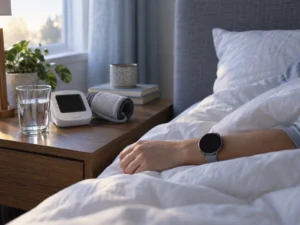
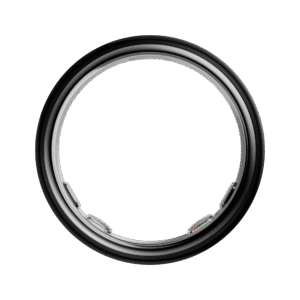
So the sequence is: buy or borrow a proper upper-arm cuff, take three readings, type them in, and from then on the ring produces an estimate derived from optical sensor data mapped against those anchors. The hardware doing the sensing is a 3-LED photoplethysmography sensor, plus a single-lead ECG, an accelerometer and a temperature sensor.
Calibration is the whole thing
This is the part people will get wrong, so it is worth being blunt. The accuracy of every reading you ever get depends on three numbers you typed in at the start.
If your cuff was unvalidated, if you took the readings straight after coffee or a flight of stairs, if the cuff was the wrong size for your arm, or if you were sitting badly, the model is anchored to bad data. It will still produce confident-looking numbers afterwards. It will produce them wrong, consistently.
Blood pressure also drifts over months with weight, medication, season and age. An anchor set in September does not stay true forever, and Circular’s September bug fix around recalibration prompts suggests re-anchoring is a recurring part of ownership.
What the reading is good for, and what it is not
Treat the output as a direction, not a diagnosis. That is not a hedge, it is the design.
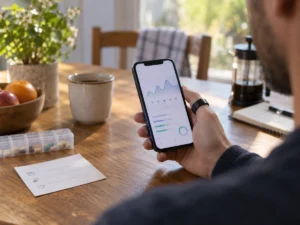
A cuff answers “what is my blood pressure right now”. This answers “is my pressure trending above or below my own normal over recent weeks”. The second question is useful. Most people with rising blood pressure have no symptoms and find out at a routine appointment years later. A trend line that nudges you to book that appointment has real value.
What it cannot do is replace a measurement in any situation where the exact number matters. Medication titration, a hypertensive episode, pregnancy monitoring, a reading your doctor will act on: all of those need a cuff. Circular says so, and the app’s ECG carries a matching caveat, that “the reading is designed to be shared with a clinician and is not a substitute for a diagnosis.”
Whether any regulator has cleared or approved the blood pressure feature is not stated on the page. Ask before you rely on it for anything clinical.
Glucose is next, and it deserves more scepticism than this
Circular lists a “Glucose Circle” at 75 percent in its ongoing development notes and advertises a “non-invasive glucose trend estimate” as coming soon.
Non-invasive glucose sensing has defeated well-funded teams for two decades. A trend estimate is a softer claim than a measurement, and it may well be useful. It is also the exact category where careful wording hides how much is being promised. When it arrives, the questions to ask are the same ones that apply today: what is it calibrated against, what does the company say it is not, and has anyone outside the company checked.
Price, and what sits behind a paywall
The Ring 2 lists at $299.95, reduced from $349.95, in titanium. Circular states 14-day returns, a one-year manufacturer warranty with two years in the EU under local consumer law, and eligibility for HSA and FSA spending in the United States. Phone requirements are iOS 15 or later and Android 9 or later. Water resistance is quoted at 50 m for up to 30 minutes.
On subscriptions, Circular’s position is unusually direct: “Nothing you need to see your own health is behind one. All essential core health tools and Kira, are included with the ring. A few Pro features can be unlocked in the app if you want them, always optional, never required.”
That is a real point of difference in this category. Compare it with the membership structure that sits behind the Oura Ring 5 and its subscription, where the monthly fee decides which insights stay visible. Both models can be defended. Only one of them lets you stop paying and keep reading your own data.
Two numbers on Circular’s own page that disagree
Worth flagging, because it affects a buying decision. Circular’s specification block for the Ring 2 says battery life is “up to 7 days” with a charging case that takes “about 60 minutes”. The frequently asked questions on the same page say “up to eight days depending on how often you take ECG readings and run live measurements” and that “a full charge takes about ninety minutes on the dock”.
Seven days or eight, sixty minutes or ninety. The gap is small and the fix is obvious, but if battery life is the reason you are choosing between rings, ask support which figure is current before trusting the larger one.
Should you buy a ring for this?
If you already own a Ring 2, update the app, borrow a validated cuff, take the three readings properly, and use the trend for what it is. It costs you nothing and the information has some value.
Anyone buying specifically for blood pressure should get a validated upper-arm cuff first. It costs far less, it gives you a real number, and the ring’s feature is worthless without one anyway. The ring is a reasonable purchase if you want continuous sleep, recovery and ECG data with no mandatory subscription, and the pressure trend is a bonus on top of that.
What would change this advice is published validation from someone other than Circular, measured against cuff readings across a range of ages and skin tones. Until that exists, the ring gives you a well-presented direction and the cuff gives you the number.