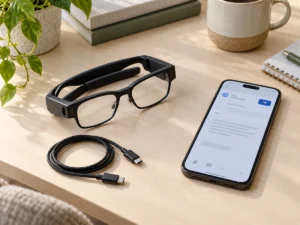

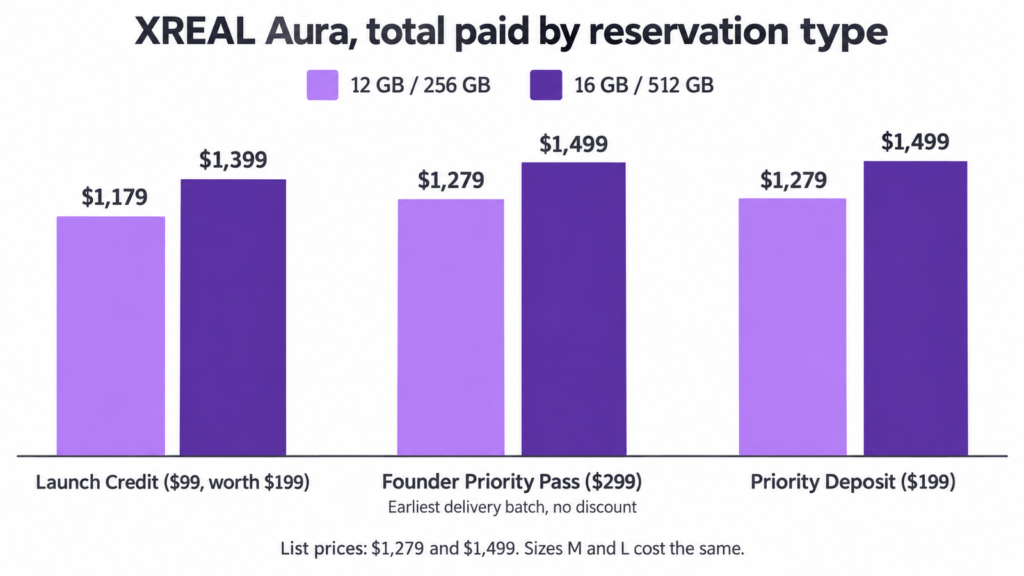
XREAL put prices on Aura, its Android XR glasses with a pocket compute puck, on October 7. The model with 12 GB of memory and 256 GB of storage costs $1,279, and the one with 16 GB and 512 GB costs $1,499. Nobody can order one outright yet: 9to5Google reports that pre-orders open later this month for people holding a $199 Priority Deposit, and that the first deliveries arrive before the holidays. What you pay in the end depends on which of XREAL’s three reservations you hold, and the cheapest route to the base model comes to $1,179.
Three reservations, three final prices
There have been three ways to reserve a place in the queue, and the US page for Aura still describes all of them. The Launch Credit cost $99 and is worth $199 toward the glasses. That makes the base model $1,080 at checkout, or $1,179 counting the $99 already paid, and the 512 GB model $1,399 all in.
The Founder Priority Pass cost $299, applies in full to the purchase and was limited to 2,000 reservations worldwide. It buys no discount. What it buys is guaranteed delivery in the earliest batch and a numbered Founder edition, so a Founder pays the same $1,279 or $1,499 as everyone else, only sooner.
The Priority Deposit is what XREAL now offers anyone who missed the first two. The page calls it $199 of “Product Credit,” and 9to5Google says the whole deposit goes toward the price, so the total stays at list. XREAL’s FAQ says reservations are fully refundable until you confirm the final purchase.
Aura comes in M for eyes 60 to 66 mm apart and L for 66 to 72 mm, measured as interpupillary distance (IPD), and 9to5Google reports no price difference between the two sizes. Prescription wearers get an empty insert frame in the box, and the box list includes no corrective lenses to put in it.
The page names two different launch lists
The line under the prices says Aura starts “with the US, Canada, Japan, and South Korea,” with more regions later. The FAQ on the same page lists the US, the UK, 24 EU countries, Japan and South Korea, and no Canada. That FAQ also still says final pricing will be “announced closer to launch” and will not exceed $1,500, so it was written before October 7, and the line by the prices is the current one.
Both lists include the US. The newer line leaves out the UK and the EU, and XREAL has not given those markets a date.
What sits in the puck and what plugs into it
The glasses weigh 95 g and use Sony micro-OLED panels at 1920 x 1200 per eye, with a 70-degree field of view, up to 1,050 nits and up to 120 Hz. The lenses darken electronically in five steps, blocking up to 99.9% of outside light for films and staying clear when you need to see the room. A camera with a privacy LED, two tracking cameras and hand tracking let Gemini answer questions about what you are looking at.
The work happens in the puck, which runs Android XR on a Snapdragon Reality Elite chip and holds a 4,455 mAh battery. One USB-C port feeds the glasses. The other charges the puck at up to 57 W and also accepts DisplayPort video, so a laptop or a handheld console can use Aura as a large private screen.
The spec sheet gives the battery a capacity and no rated runtime. The box contents name a charging cable and no power adapter, so a USB-C charger with Power Delivery comes from your own drawer.
Next to the glasses already on sale
The Meta Ray-Ban Display costs $799 in the US and has a screen in one lens only. Aura costs $480 more at its base price and does a different job. It runs Google Play apps in up to five floating windows, and it works only with the cable to the puck plugged in.
Aura suits someone who wants a private monitor and an Android XR computer to wear on a flight, where XREAL’s travel mode keeps the picture steady. The pre-order window later this month is the next date to watch, and 9to5Google expects a second delivery wave in early 2027 for anyone who misses the first.