
Withings began switching on StethO Sense for BeamO owners in the US on October 1, 2026. The feature sends a heart or lung recording from BeamO’s built-in stethoscope to two outside companies and returns a verdict within about ten seconds: whether the heart software hears an abnormal murmur, and a 0 to 100 Breathing Index for the lungs. It comes only with Withings+, at $9.95 a month or $99.50 a year. The murmur check’s accuracy was measured on recordings where half the people had a murmur, so at home, where far fewer do, a large share of “abnormal” results will be false alarms.
Who gets it, and when
You need a BeamO, an active Withings+ plan, the Withings app at version 26.40 or later and BeamO firmware 771 or later, and you need to be in the US. Withings’ support page says the feature is “rolled out over the month of October, 2026 by region,” so an owner who meets every condition may still not see the tile for a few weeks. Without Withings+, tapping the tile opens the subscription page.
BeamO lists at $249.95. Anyone who buys one from October 1 gets a month of Withings+ free, and so do owners who bought before that date. After the free month, the device and a year on the annual plan come to $349.45, while paying monthly costs $119.40 over the same twelve months, $19.90 more.
Every analysis sends the recording off your phone, heart sounds to eMurmur, made by CSD Labs, and lung sounds to StethoMe. The app asks for consent the first time you launch StethO Sense, and you can change that choice later in its settings.
What the heart check returns
The heart analysis works on recordings from the four standard listening spots on the chest, the aortic, pulmonary, tricuspid and mitral areas. It does not accept the apex recordings made with Withings’ BPM Core blood pressure monitor. Each result is “No abnormal murmur” or “Abnormal murmur detected,” with a high, medium or low confidence level, or a request to record again when the sound is too poor to read.
Withings’ own advice for an abnormal result is mild. It “does not indicate an emergency medical condition,” and if a repeat recording in the same position again comes back abnormal with high confidence, you should “inform your doctor at your next regular visit.”
Why most alerts at home will be false
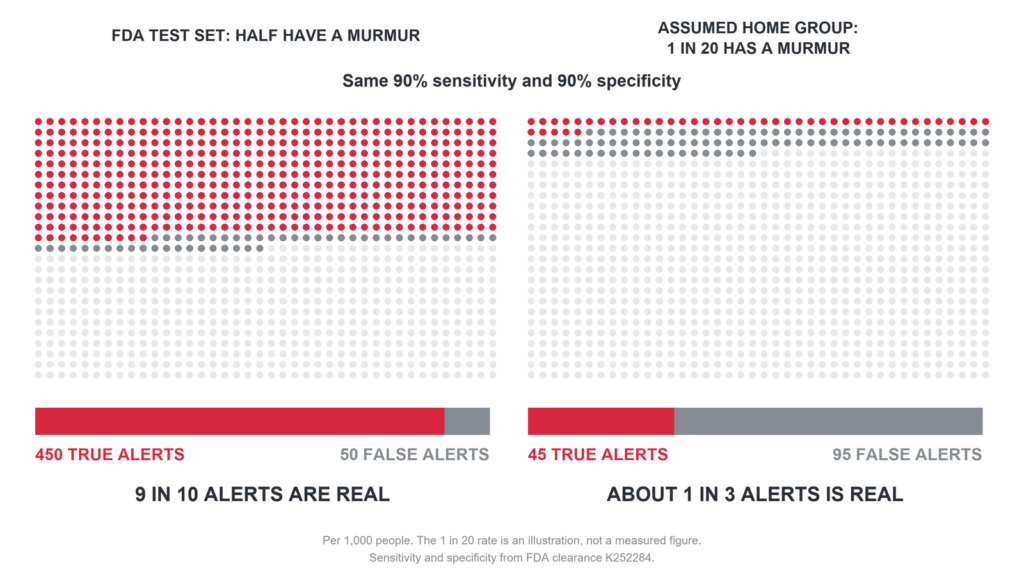
The FDA cleared the current heart software, eMurmur Heart AI 2.2, on December 19, 2025, under K252284. Its validation set was split evenly: half the recordings came from people with a confirmed abnormal murmur, as judged by three cardiologists, and half from people without one. On that set the software scored 90 percent sensitivity and 90 percent specificity. In plain terms, it caught nine in ten real murmurs and cleared nine in ten healthy hearts.
The split decides how often an alert is right. In a group where half have a murmur, nine in ten alerts are real. Withings’ launch notice cites a Norwegian study in which nearly one in four adults had a heart murmur, and adds that many are harmless. The software is meant to flag only the abnormal ones, and nobody has published how common those are among BeamO owners, so take one in 20 as an assumption to show the arithmetic.
Out of 1,000 people at that rate, 50 have a murmur and the software flags 45 of them. Of the 950 without one, it wrongly flags 95. That is 140 alerts, and only 45 of them, about a third, are real. A clear result holds up much better: 855 of the 860 people told “no abnormal murmur” are right.
Withings’ press release quotes a separate study of 603 patients with 93 percent sensitivity and 81 percent specificity. At the same assumed rate, those figures make the picture worse, with about one alert in five real, because more healthy hearts get flagged.
So Withings’ advice to repeat the recording before acting has a numerical reason behind it. A single abnormal result is weak evidence on its own. A repeated one, with high confidence, is worth taking to the next appointment, along with the recording itself.
Who the clearance was written for
The clearance describes “a decision support system” for use “in settings where auscultation can be performed properly by a healthcare provider,” and says its interpretations “are only significant when considered in conjunction with healthcare provider over-read.” The summary expects the person using it to be a healthcare provider licensed or trained to listen to hearts. Withings’ launch material pitches the feature to parents recording their children and to athletes, and its own footnote says “final clinical assessment must be performed by a qualified healthcare provider.”
The summary never names BeamO, and says recordings come from “any supported digital stethoscope,” that the list sits in a table in the product’s labeling, and that new stethoscope models can be added under a plan the FDA approved in advance. The version before it was cleared with a single model, the Littmann 3200. Withings has not published which entry on that list, if any, covers BeamO.
The breathing score is a wellness feature
The lung analysis has no FDA clearance. Withings offers StethoMe’s Breathing Index in the US as a general wellness feature, the same line between wellness and medical clearance that Google draws for its watch’s blood pressure trends. It uses eight recording positions, or six for children under 12, and reports an inhale to exhale ratio and a breathing rate alongside the score.
Withings says the index is not for people with diagnosed asthma, COPD, bronchitis or bronchiolitis. Its support page also leaves a gap in the scale: a score under 25 is “Optimal,” 25 to 49 is “Fair,” over 70 is “Notable,” and nothing explains a score from 50 to 70.
Whether to pay for Withings+
If you already own a BeamO and listen to a child’s or your own chest because a doctor asked you to, the free month is a fair trial, and the app exports a report you can hand to that doctor. Buying a BeamO to screen a healthy family for murmurs is harder to justify, because in that setting most of the alerts it raises are likely to be false.