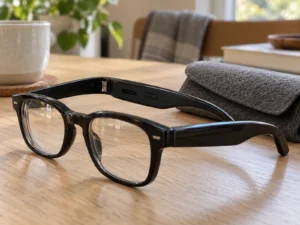

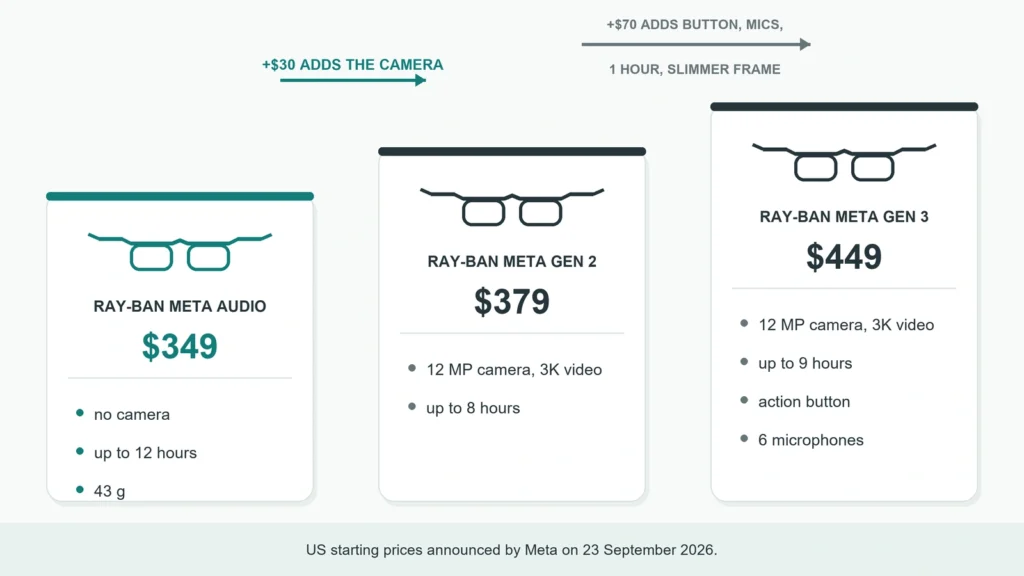
Thirty dollars is the price of the camera in Meta’s new line-up. Ray-Ban Meta Audio, announced at Connect on 23 September 2026, starts at $349 in the US and ships on 13 October. The Ray-Ban Meta Gen 2, which stays on sale, starts at $379. The new Gen 3 starts at $449. So the camera-free model saves you little money, and that changes how to think about it. Ray-Ban Meta Audio makes sense for people who do not want a camera on their face, and for anyone who mostly uses smart glasses as open-ear headphones with an assistant. For everyone else the camera is cheap enough to keep.
Three pairs, side by side
Meta’s own comparison page puts the three current Ray-Ban models in one row. The weights for the Wayfarer frames come from Engadget’s measurements of the Gen 3 and Gen 2.
| Ray-Ban Meta Audio | Ray-Ban Meta Gen 3 | Ray-Ban Meta Gen 2 | |
|---|---|---|---|
| US starting price | $349 | $449 | $379 |
| Camera | None | 12 MP, 3K video | 12 MP, 3K video |
| Battery per charge | Up to 12 hours | Up to 9 hours | Up to 8 hours |
| Button | Customisable action button | Customisable action button | Capture button |
| Weight | 43 g | 51.5 g (Wayfarer) | 51 g (Wayfarer) |
| Styles | Clubmaster, Burbank | Aviator, Zena, Wayfarer | Wayfarer and others |
| Availability | Pre-order, ships 13 October | On sale now | On sale now |
Meta quotes the new models in US dollars only. It has not said when the Audio frames reach other countries or what they will cost there.
What the Audio model does without a camera
The Audio pair is, in Meta’s words, “built without a camera and more powerful than headphones”. Open-ear speakers in the arms play music, podcasts and calls while leaving your ears free to hear traffic and people. Meta AI still answers by voice, so you can set reminders, send messages and ask questions without taking out your phone. The action button from the Gen 3 is there too.
What goes is everything that depends on seeing. Photos and video are the obvious loss. The less obvious one is the assistant’s eyes. Any request that needs the camera, such as asking what you are looking at or having a sign read out, cannot work on a pair that has no lens.
The frames themselves are built for all-day wear. Meta lists professional-adjustable temple tips, adjustable or swappable nose pads and overextension hinges, and says both styles take “a wide range of optical prescriptions”. At 43 g they weigh about 8 g less than a Gen 3 Wayfarer, roughly a sixth lighter.
The battery gap, in days
The Audio model is rated for up to 12 hours on a charge, and its case holds another 48. That adds up to 60 hours between wall sockets. At three hours of listening and calls a day, it comes to about 20 days before the case itself needs charging. Meta pitches the glasses alone as a full day of calls, music and Meta AI.
The Gen 3’s rating is an hour better than the Gen 2’s, and three hours short of the Audio pair. For most people that hour will not change how often they charge.
When a pair without a camera is the right one
Meta’s announcement never mentions privacy, but it is the clearest reason to pick this pair. Camera glasses are now banned by the house rules of some concert halls, theatres and bars, and on 22 September the Dutch privacy regulator asked hospitals, courts and places of worship to do the same. A pair with no camera takes that argument off the table. Nobody at the next table has to wonder whether the white light is on.
It also suits people who treat smart glasses as headphones first. If you have owned a Ray-Ban Meta and never used the camera after the first week, you have paid for hardware you do not use. The Audio pair drops it, adds three hours of battery and loses weight.
There is one thing it is not. It is not a hearing product. EssilorLuxottica’s Nuance Audio Plus also has no camera, but it is built to amplify the voice in front of you. Meta’s own speech amplification is a paid add-on, and Meta has not said which frames get it first, as our piece on Meta hearing enhancement sets out. Do not buy the Audio pair on the assumption that it will.
Gen 3 or Gen 2 if you want the camera
The Gen 3’s $70 premium buys a slimmer frame, the action button, six microphones that Meta says cut more than 90 percent of background noise, an hour more battery and three new styles. The camera specification is the same 12 MP and 3K video. Dolby Atmos spatial audio recording is promised for later this year.
Owners of a Gen 2 can skip the upgrade, because the camera is unchanged. For a first pair, the Gen 3 is worth the difference if you make many calls outdoors, where the microphone change should matter most.
Still open before 13 October
Three answers would change this advice. Meta has not said which countries get the Audio pair, or when. It has not named the frames that will get the paid hearing feature. And nobody outside Meta has yet measured the open-ear speakers against earbuds, which is the comparison a buyer of the Audio model will care about. The pair does not ship before 13 October, so waiting for the first independent reviews costs you nothing but a few days.