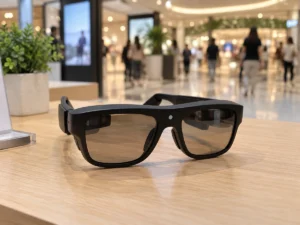
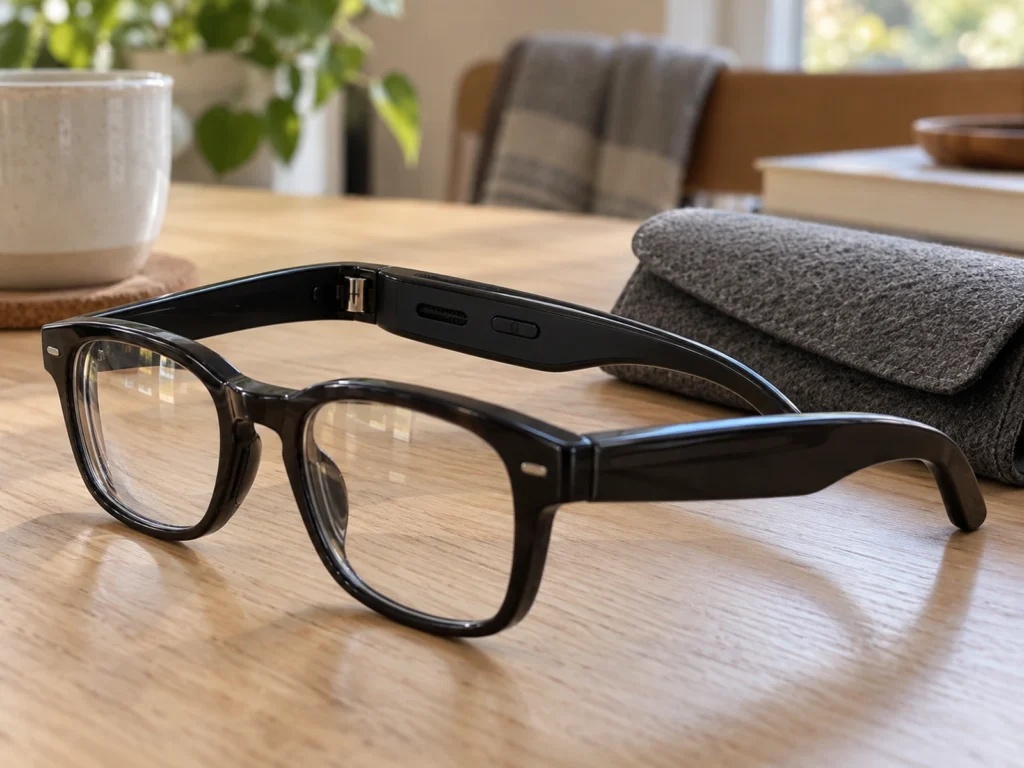
EssilorLuxottica put the Nuance Audio Plus on sale on 22 September 2026, starting at $829 depending on the lenses you order. These are hearing glasses, with no camera, no assistant and no display. Microphones in the temples pick up speech and small speakers above your ears play it back, louder and aimed at the person in front of you. The new generation adds a feature the first one did not have at all, answering a phone call with a double tap on the temple. EssilorLuxottica sells the range to adults with perceived mild to moderate hearing loss, and the call feature carries a footnote worth reading before you pay.
The call feature works on an iPhone and nowhere else
EssilorLuxottica’s own comparison page is explicit about it. “The product, as an MFI certified device, supports voice calls only when used with an iPhone (requires iOS 16 or later).” The first-generation Nuance Audio Glasses are listed as having no phone call support at all, so the feature is new, and partial.
MFi is Apple’s Made for iPhone accessory programme. Hearing devices that join it connect to an iPhone over a method Apple controls, and Android uses a different one, so support on one platform does not carry across to the other.
EssilorLuxottica’s pages do not say what an Android owner gets instead, and that gap matters. Carry a Pixel or a Galaxy and you should treat the calling feature as absent until the maker says otherwise. Judge the glasses on how well they amplify a conversation, which is what they were built for.
What you get for the extra $130
The original Nuance Audio Glasses are still sold at $699, so the Plus asks for $130 more. Four things account for it.
Battery is the first. EssilorLuxottica lists the Plus at “up to 10h under average use conditions” against “up to 8h” for the original. A full charge now takes about four hours, up from three, and the charging pad is in the box. Folding the temples puts the glasses to sleep, unfolding them wakes them, which is the behaviour that decides whether ten hours covers a real day.
The controls are the second and, day to day, probably the bigger change. A slider handles on and off. Separate buttons handle volume and presets. A double tap switches between the frontal and 360 degree microphone modes, and answers a call. The original puts on, off and volume on a single multifunction button, and anyone who has fumbled one of those in a restaurant knows why the change matters.
Third, the speaker. EssilorLuxottica describes the Plus as having “stronger amplification and warmer sound” against “normal amplification for everyday hearing support” on the original. No measurement backs that wording, and the company does not publish a gain figure on these pages.
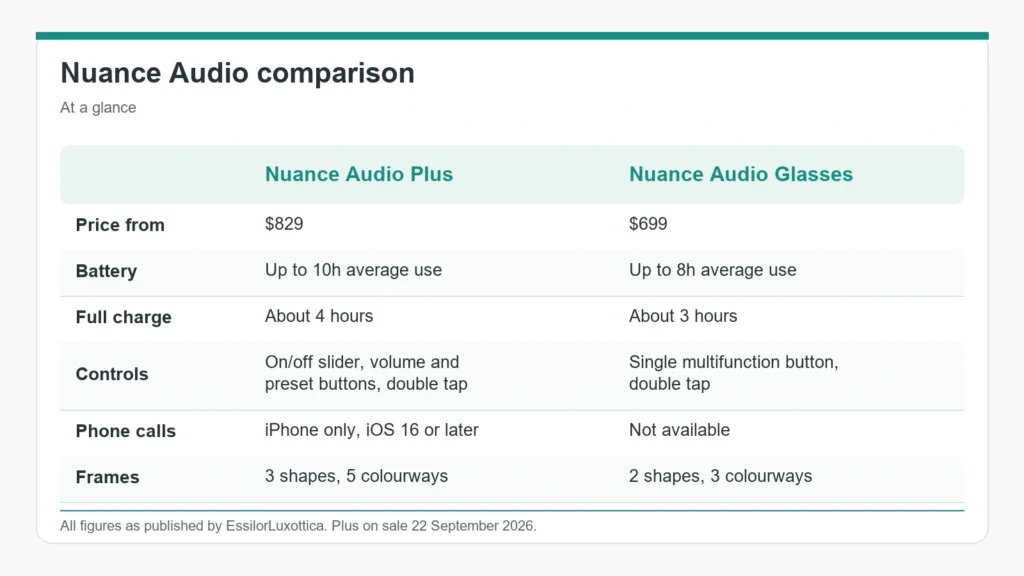
Fourth, choice. The Plus comes in three frame shapes, Panthos, Upturn and Square, each in five colourways. The original comes in two shapes and three colours. When a hearing device has to sit on your face all day, the shape it arrives in is not a trivial spec.
What the app adjusts
This is where hearing glasses differ from a hearing aid fitted by an audiologist. The Nuance Audio app gives you two microphone modes, frontal for a conversation across a table and all-around for everything else. Underneath that sit four preset amplification profiles labelled A to D, three levels of background noise reduction, and a volume scale of one to five.
That is a set of presets you choose between, not a response curve shaped to your own audiogram. If your hearing has dipped gently and evenly, a preset can land close enough to be useful. A steep high-frequency loss in one ear is another matter. No number of taps will fix that. EssilorLuxottica sells the range for adults with perceived mild to moderate hearing loss, and the wording in its launch announcement stays inside that boundary.
The lens is the part most smart glasses get wrong
Nuance Audio comes from an eyewear company, and it shows in the boring places. You order the frames with clear prescription lenses, Transitions Gen S photochromics, or blue-violet light filtering, the same menu you would get on any pair from the same group.
Compare that with the usual route on a camera-equipped pair, where you order a separate insert, check a supported prescription range, and hope your cylinder falls inside it. Our guide to ordering prescription lenses for Rokid Glasses walks through what that process demands. Nuance skips it, because the lens was never an afterthought here. It also means you are buying a hearing device and your actual glasses at once, which is a fairer comparison against the cost of both.
Where you can buy a pair
Distribution is the quiet advantage of a hearing device sold by the world’s largest eyewear group. The Plus goes out through authorised optical and hearing care shops, with online sales in selected countries, and Stefano Genco, who runs Nuance Audio, put the first year’s reach at “14 countries and more than 18,000 stores”.
That is a different proposition from a direct-to-consumer hearing device shipped from a warehouse. Someone can adjust the nose pads, glaze the lenses to your prescription, and take the frames back if they sit wrong. For a product you wear on your face for ten hours a day, that matters more than any spec on this page.
Before you order
Get a hearing test first, from an audiologist, and take the result with you. The company runs an online screening test and books free in-store demonstrations. Do the demo in a noisy part of the shop, outside the quiet consulting room. Ask to try the frontal mode with someone talking to you while other conversations run behind you. That is the situation these are built for, and the one where a preset either works for your ears or does not.
Check the return window too. EssilorLuxottica gives US buyers 30 days to send them back free, which is roughly how long it takes to learn whether you reach for the glasses each morning or leave them on the side.
Two things the company has not published on these pages are a measured gain figure and any statement about Android support. Both are reasonable questions to put to a stockist before handing over $829.