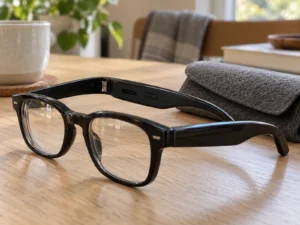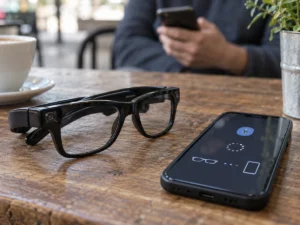

Meta announced on 23 September 2026, at its Connect event, that its AI glasses will be able to amplify speech for people with mild to moderate hearing loss. Meta calls the software Meta hearing enhancement and describes it as FDA-cleared. It will cost $149.99 as a one-off add-on, or come with a Meta One subscription, and it launches in the US “later this year”. If you already wear Meta glasses and find restaurants harder than you used to, the same frames could soon amplify the person across the table.
What Meta has confirmed
Meta’s own announcement is short and precise. “Hearing enhancement is an FDA-cleared software feature that helps adults 18 and older with perceived mild to moderate hearing loss hear better, coming to supported AI glasses.” It adds that setup happens “at home in minutes”, with “no clinic or prescription needed”.
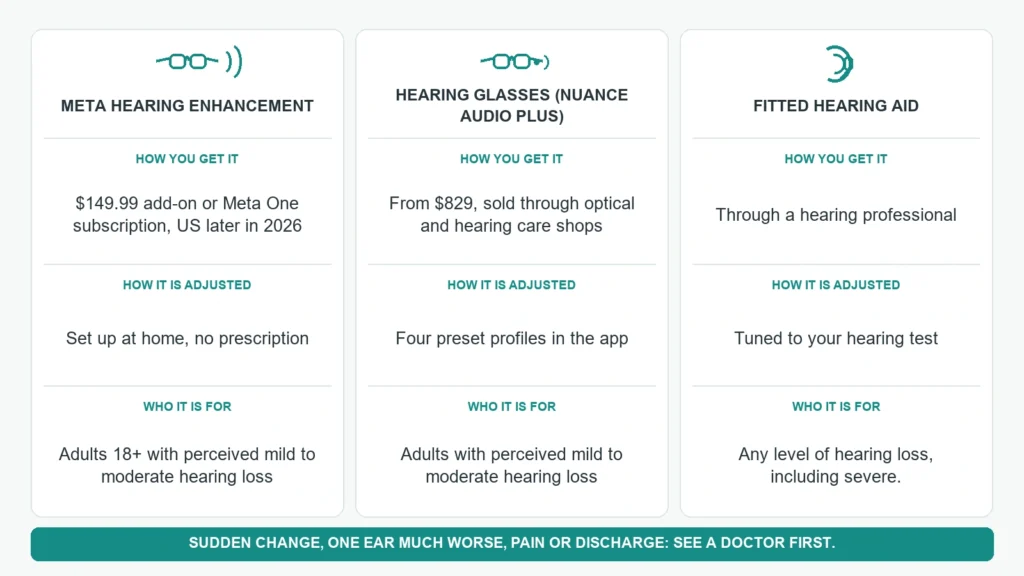
The price is $149.99, and Meta marks it as eligible for HSA and FSA reimbursement. A footnote tells you to check your own plan to confirm that. Engadget, reporting from the event, adds two details Meta’s summary leaves out. There will be a 30-day free trial before you pay, and you switch the mode on and off by voice, with “Hey Meta, start Hearing Enhancement”.
Two smaller audio settings came with the news, and they reach every wearer whether or not they buy the add-on. Audio balance shifts sound toward the left or right ear, and mono audio sends everything to one side. For someone with one weaker ear, those two settings may be worth trying before spending anything.
Which glasses get it first
Meta’s announcement says “supported AI glasses” and stops there. It does not publish a model list. According to Engadget, the rollout starts with Meta’s own-brand Meta Glasses line, and Ray-Ban models are not included, “at least to start”. Meta has not said when, or whether, the Ray-Ban frames follow.
That matters if you are shopping this autumn. Meta also launched the Ray-Ban Meta Gen 3 at $449 and the camera-free Ray-Ban Meta Audio at $349 on the same day. Buying either one on the assumption that the feature will arrive on it is a gamble until Meta names the supported frames.
How this fits the hearing aid rules
The wording Meta chose, adults 18 and older with perceived mild to moderate hearing loss, is the same group the FDA’s over-the-counter hearing aid rules cover. Those rules took effect in October 2022 and let adults buy hearing help without an exam or a prescription. “Perceived” means you decide you have trouble hearing, and nobody has to measure it first.
There is a precedent in the wider market. In September 2024 the FDA authorised Apple’s hearing aid software for AirPods Pro 2, the first over-the-counter hearing aid software of its kind. Apple shipped it as a free update to earbuds people already owned. Meta is taking a different route, charging $149.99 on top of the glasses, so the add-on has to earn its price rather than arrive as a bonus.
What is missing so far is the paperwork. Meta has not published the FDA clearance number, the date of the clearance, or the regulatory pathway it used. Until those appear in the FDA’s own database, the “FDA-cleared” claim rests on Meta’s announcement.
How it compares with glasses built for hearing
Glasses that amplify speech already exist. EssilorLuxottica, which makes Meta’s Ray-Ban frames, already sells hearing glasses with no camera and no assistant. Our piece on Nuance Audio Plus and its iPhone-only call support covers the newest pair, which starts at $829 and adjusts sound through four preset profiles in its app.
The two approaches start from opposite ends. Nuance is a hearing product that happens to be a pair of glasses, sold and adjusted in optical shops. Meta’s version is a paid mode inside AI glasses that also record video, play music and answer questions. If amplification is the main reason you want smart glasses, a purpose-built pair is sold with that job at its centre. If you already own supported Meta glasses and your hearing has started to slip, a $149.99 add-on with a free month to test it is a much smaller bet.
What Meta has not said
Several questions a buyer would ask have no answer yet.
- The price of Meta One, the subscription that includes the feature.
- A launch date more specific than “later this year”.
- Whether it will reach the UK, Canada or the EU, where Meta also sells its glasses.
- How the setup tunes the sound to your ears, and how much battery the mode uses over a day.
The battery question is the one to watch. Amplifying speech means the microphones and speakers run the whole time you have it switched on, and Meta has published no figure for that.
Before you rely on it
If your hearing changed suddenly, if one ear is much worse than the other, or if you have ear pain or discharge, see a doctor before buying any over-the-counter hearing product.
For everyone else, the sensible order is to wait for Meta’s supported-model list, use the 30-day trial in the places you struggle most, such as a busy restaurant or a meeting room, and decide at the end of the month. A hearing test from an audiologist first gives you a baseline, so you can tell whether the glasses help or you have got used to them.