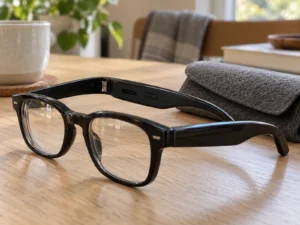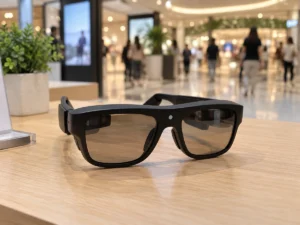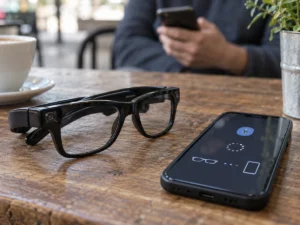
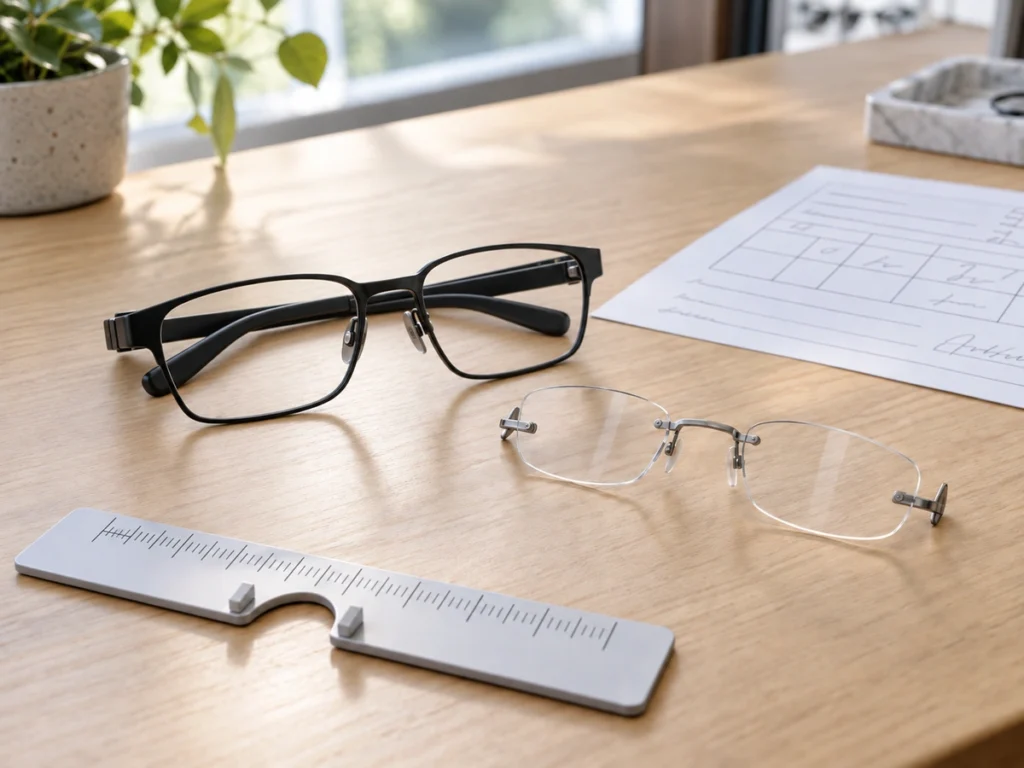
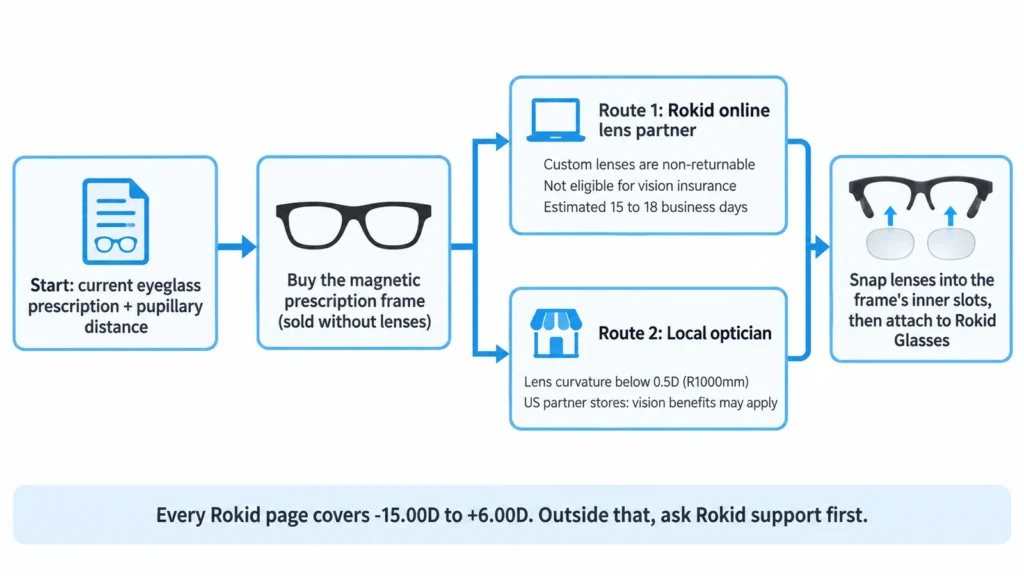
Rokid Glasses prescription lenses do not replace the lenses that carry the display. Rokid sells a separate magnetic prescription frame instead, and it snaps onto the inner side of the glasses. You fill it with corrective lenses. Those come either through Rokid’s online lens service or from a local optician. Everything here comes from Rokid’s published documentation as checked on 17 September 2026. We have not fitted or worn a pair ourselves, so nothing below describes personal use.
How prescription lenses work on Rokid Glasses
Both lenses of Rokid Glasses carry a green Micro LED waveguide display that shows text and simple graphics. Because those lenses do the display work, Rokid does not grind your prescription into them. The correction sits in a second, thin frame behind them.
That part is the Rokid Glasses Prescription Frame. Rokid describes it as a titanium alloy frame with a clip-on magnetic design, made only for Rokid Glasses. It ships without lenses. Rokid sells it separately in its own store, and the price differs by region.
This matters when you read advice online. The display-free Rokid AI Glasses Style uses a different method, with prescription lenses fitted directly into the main frame. So a lens guide written for the Style model does not automatically apply to the display model.
Which prescriptions Rokid says it supports
Rokid’s documents agree on the basics. The magnetic frame takes custom lenses for myopia (short-sightedness) and astigmatism. The exact numbers, though, differ from page to page.
| Rokid page | Stated prescription support |
|---|---|
| Rokid Glasses specification table | +15 to -15 |
| Help centre comparison of Rokid Glasses and AI Glasses Style | Up to ±15.00D (1500 degrees), plus progressive multifocal lenses |
| Help centre prescription question | +6.00D to -16.00D |
| Prescription Frame product page | 0 to 1600 degrees, myopia and astigmatism |
The “degrees” figure follows a convention common in Chinese optical retail, where 100 degrees equal 1.00 dioptre. So 1600 degrees means 16.00D of correction. We quote the +15.00 to -15.00D range from the specification table, because that is the headline figure on Rokid’s own product page.
Every page covers strong short-sightedness down to about -15.00D. The disagreement is on the plus side, for long-sightedness (hyperopia), where one page stops at +6.00D and another reaches +15.00D. Progressive lenses appear in only one of the four documents. Rokid has not published a single answer on the plus-side limit or on progressive support.
So a prescription between -15.00D and +6.00D, for myopia or astigmatism, falls inside every range Rokid publishes. Outside that band, or if you need progressives, email Rokid support with your prescription before you buy. Then keep the written reply.
Option 1: Rokid’s online lens service
Rokid recommends its own online service as the best fit for the frame. The lenses do not come from Rokid itself, though. An official optical partner makes and ships them, according to the lens service page, and that partner’s policies govern verification, pricing, delivery, returns and customer service. Rokid also says it does no eye exams and no prescription verification.
Before ordering, you need two things:
- a current eyeglass prescription from a qualified optometrist
- your pupillary distance, the gap between the centres of your pupils
A contact lens prescription will not work, since Rokid says the two are not interchangeable. Depending on your prescription and lens type, the partner may also ask for more details.
The terms deserve a careful read. Rokid’s prescription FAQ, dated 26 January 2026, says custom lenses are non-returnable. It also says online prescription orders cannot be claimed on vision insurance. The same FAQ estimates delivery at 15 to 18 business days, with lenses shipped from China. Separately, Rokid’s help centre notes that lens production time is not included in its normal shipping estimates.
Option 2: a local optician
Rokid also allows a local route. You buy the magnetic frame, then take it to an optical store to have lenses made.
One technical condition has to reach the optician. Rokid asks that the lens curvature stay below 0.5D, which it gives as a radius of 1000 mm, so the lenses must be close to flat. More curved lenses may not fit the frame and could cause installation problems, Rokid warns. Tell the optician about this limit before any lenses are cut.
This route may suit you if you prefer an in-person fitting. Even so, Rokid still recommends its own service for the best fit. If locally made lenses do not sit correctly, sorting that out would depend on your agreement with the optician. That last point is our reading of the situation, not a Rokid policy statement.
Vision benefits and US partner stores
The insurance picture differs by route. Online orders through Rokid’s lens partner are not eligible for reimbursement, according to its FAQ. By contrast, the lens service page says participating optical retailers can help you try on the glasses and explore lens options. It adds that prescription lenses bought that way may qualify under a vision benefits plan.
In-network customisation is limited to the US in Rokid’s specification table, which says it “may be available depending on provider and plan.” Rokid does not name the providers on those pages. Check coverage with both the retailer and your benefits provider before you pay.
Fitting the insert and daily wear
Rokid’s help centre gives short installation steps. First, align the two slots on the inner side of the frame. Next, press gently on the outer slot until the lenses snap into place, and avoid scratching them as you do so. Rokid has also published a video tutorial on its prescription FAQ page.
The glasses weigh 49 g, and the box includes interchangeable nose pads in several sizes. Rokid does not publish the combined weight with the prescription frame fitted. For sunny days, Rokid sells separate clip-on sunglasses for the display model.
Checklist before you order
- Get an eyeglass prescription that is current, not a contact lens one.
- Measure or ask for your pupillary distance.
- Compare your numbers with the -15.00D to +6.00D band that all Rokid pages cover.
- Ask Rokid support in writing if you are outside that band or need progressives.
- Budget for the frame itself on top of the glasses and the lenses.
- Accept that custom lenses from the online service cannot be returned.
- If you use a local optician, pass on the 0.5D (R1000mm) curvature limit.
- In the US, check partner retailer coverage before assuming insurance applies.
Rokid Glasses prescription lenses are well supported for most short-sighted and astigmatic wearers. Still, the conflicting ranges mean long-sighted buyers and progressive-lens wearers should get confirmation first. A written answer from Rokid costs nothing, while a non-returnable pair of custom lenses does.