
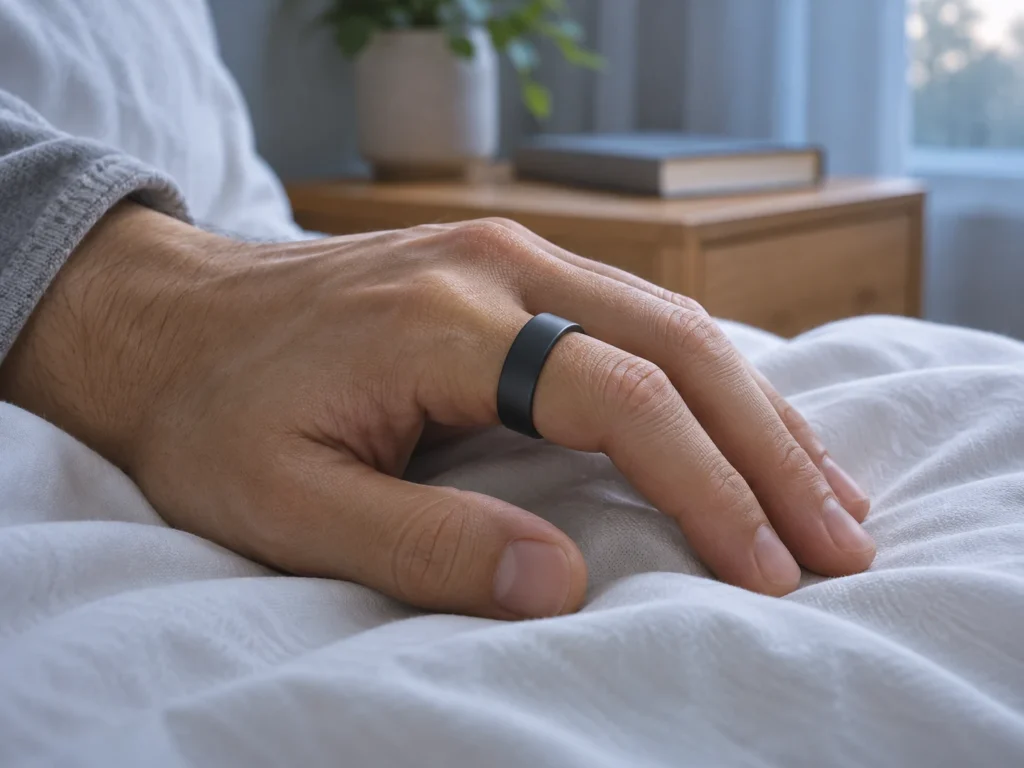
The revised Ultrahuman sleep study does not establish that moving your bedtime lowers glucose. It found no clear between-person association between bedtime irregularity and average overnight glucose. The stronger associations involved sleeping heart rate and variation in sleep duration, and none proves cause and effect.
The revised paper was posted on October 27. It is a medRxiv preprint and has not been peer reviewed.
Who was in the study
The paper looks back at 105,196 nights from 2,648 adults. They lived in 87 countries. All of them wore an Ultrahuman Ring and a continuous glucose monitor at the same time, between January 2024 and June 2025. The glucose sensors were Abbott FreeStyle Libre models, used through Ultrahuman's own CGM program.
Everyone was between 20 and 60 and reported no metabolic or heart disease. About 800 of them were in North America, almost all in the US.
Ultrahuman funded the study. Three authors were company employees, another was an advisor, and another worked under a research contract. Those relationships are disclosed in the paper.
The study defines time in range as 70 to 110 mg/dL. Its authors say this narrow range is not a clinically validated measure. Participants were self-selected device users, and about three-quarters were men, which limits how widely the results can be applied.
Bedtime had the weaker association
The researchers measured irregularity three ways: how much sleep length, bedtime and wake time each moved from night to night. Then they compared people with each other, and each person's nights with their own other nights.
People whose sleep length varied by an extra 30 minutes from night to night had overnight glucose about 4.1 mg/dL higher on average. That's the figure Ultrahuman's post leads with. Wake-time irregularity showed a smaller link, about 1.1 mg/dL.
Bedtime irregularity showed no clear link to average overnight glucose between people. When the three measures were weighed together, bedtime was tied to none of the three glucose outcomes.
Within the same person, an irregular night barely moved glucose: about 0.2 mg/dL per 30 minutes for each measure. The paper puts these person-level effects at 4 to 18 times smaller than the differences between people.
So the 4 mg/dL figure describes people who sleep irregularly, and the study can't say what changing your own schedule would do. We wouldn't move a bedtime to lower glucose on this evidence.
Sleeping heart rate is the stronger finding
Within the same person, overnight glucose ran 5.7 mg/dL higher for every 10 bpm rise in sleeping heart rate. Between people, the gap was 6.5 mg/dL per 10 bpm.
Among 911 participants with at least 30 paired nights spanning at least 60 days, 701 had a positive association in their individual data, about three in four. That still does not validate using heart rate to estimate an owner’s glucose.
Within participants, a 10 bpm higher sleeping heart rate was also associated with about 6 percentage points less time in the study’s glucose range. The authors call the link modest. An observational study can't show whether heart rate drives glucose, glucose drives heart rate, or something else drives both.
Sleeping heart rate had the stronger association in this analysis, but the authors explicitly reject inferring an individual’s glucose from a single night’s heart rate. A ring reading is not a substitute for glucose measurement or clinical assessment.
What changed since March
Ultrahuman's March 13 press release described the first version of the paper, posted March 4. That version counted 5,859 adults and 227,860 nights, more than twice as many as the October one. The press release called sleep timing consistency the "single strongest discriminator" and said the data pointed to "a single cause": irregular bedtimes.
The October version starts from the same group of ring and CGM wearers, then filters it down by age, body mass index and data quality. Its revision note says the analysis changed, and in the new analysis bedtime is the weakest of the three irregularity measures.
We think the October paper is the more careful one. Ultrahuman's November post still repeats the March advice, with CEO Mohit Kumar saying anyone can start going to bed at roughly the same time tonight.
medRxiv's own warning on the preprint says it shouldn't be used to guide clinical practice until it has been evaluated.