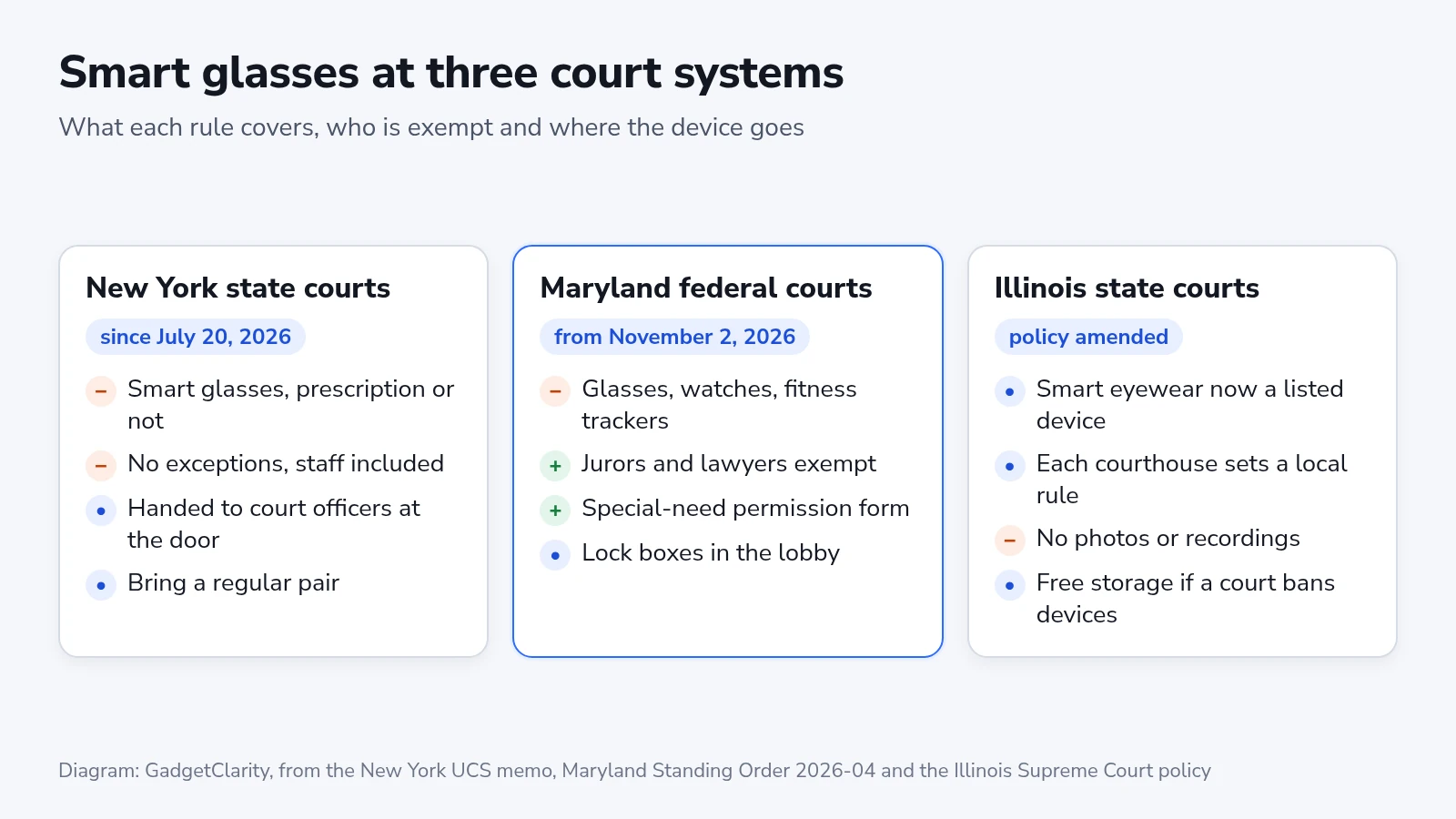
If you wear prescription Ray-Ban Meta glasses, take a regular pair to jury duty in New York. Since July 20, every courthouse run by the state’s Unified Court System has barred smart glasses, prescription or not, and anyone carrying a pair hands it to uniformed court staff until they leave. Maryland’s two federal courthouses start a wider rule on November 2 that also takes in smartwatches and fitness trackers, yet lets jurors and lawyers keep their devices. Illinois has added smart eyewear to the device policy its courthouses follow.
New York: every pair, every visitor
The rule comes from an amended July 1 memo to the state’s administrative judges. It defines smart glasses as eyewear or headwear containing “a camera, microphone, computer or other technology” that lets the wearer record video or audio, and it covers prescription and non-prescription frames alike. The stated reason is to stop people from secretly recording proceedings in breach of New York’s Civil Rights Law and court rules.
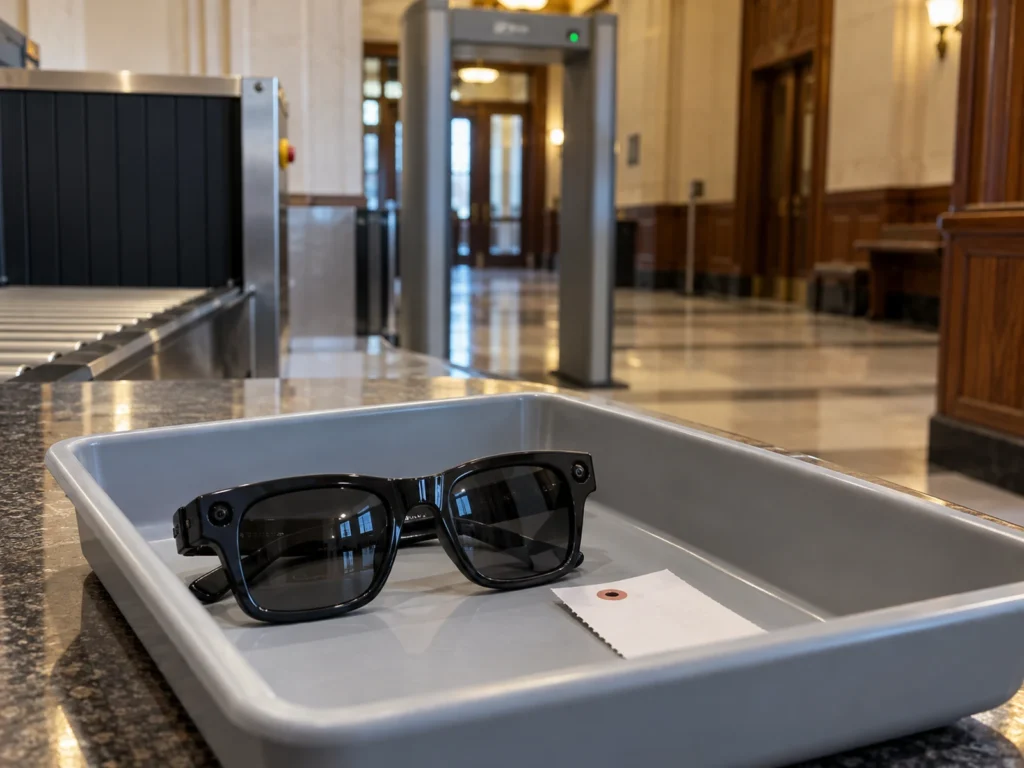
Nobody with smart glasses gets in unless the glasses are vouchered for safekeeping by uniformed personnel for as long as the person stays in the building. The memo lists who that means: litigants, attorneys, witnesses, family members, court employees and anyone else entering for any reason.
There is no exception for jurors, and none for medical need.
The sign attached to the memo tells anyone whose smart glasses have prescription lenses to bring a regular pair to use in the courthouse. Without one, a juror who needs corrected vision spends the day without it.
Maryland: every connected device and a list of exceptions
From November 2, under Standing Order 2026-04 of the US District Court for the District of Maryland, visitors to the federal courthouses in Baltimore and Greenbelt may not carry in laptops, phones, tablets, cameras, smartwatches, smart glasses, earpieces or fitness trackers, or any other instrument that can photograph, record or communicate wirelessly. Devices that stay outside go into lock boxes in the lobby until the owner leaves.
The order does not name smart rings, but its catch-all covers anything capable of wireless communications, and a ring that syncs to a phone over Bluetooth fits that description, so plan to leave one in the lock box with the rest.
Maryland lets more people keep their devices than New York does. Sitting and prospective jurors who show their summons are exempt, and so are members of the court’s bar with an electronic credential. Pro se litigants, members of the media, attorneys’ staff and “individuals with a special need” can ask in advance through the court’s Electronic Device Request form, and anyone who qualifies without having asked can request a pass from the Clerk’s Office on the day.
Illinois: glasses join the device policy
The Illinois Supreme Court amended paragraph (c)(1) of its Policy on Portable Electronic Devices to add “smart eyewear” to the list of covered devices. That policy, in force since 2022, does not ban devices. It requires every state courthouse to adopt a local rule, keeps devices silent and out of use in a courtroom without the judge’s permission, and forbids photographs and recordings. A courthouse that wants a full ban needs an order from the circuit’s chief judge and must offer free storage.
For an owner, the change means smart glasses in Illinois courthouses now follow whatever the local courthouse rule says about portable devices. Check the rule for the specific courthouse, because one county can allow devices that the next one stores at the door.
Hearing glasses fall between the rules
New York’s test is whether the glasses can record. Camera glasses fail it whatever else they do, so an owner who uses them to hear better loses that help at the security desk. Meta has said its hearing enhancement for its camera glasses reaches US owners before the end of 2026, and a pair running it would still be vouchered like any other.
Nuance Audio frames have no camera. Their microphones sit in the temples to pick up the voice of the person in front of you. New York’s memo mentions microphones only as technology that lets the wearer record, and it says nothing about glasses that amplify sound and store none of it, or about any way to ask for an exception. Maryland has one, the special-need route on its Electronic Device Request form, filed before the visit.
If your hearing depends on a pair of glasses and your summons is for a New York courthouse, call the court named on the summons before the date and ask how officers will treat them. Maryland’s lock boxes come into use on November 2, the first day a federal juror there keeps a smartwatch while most visitors leave theirs in the lobby.