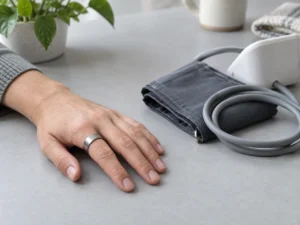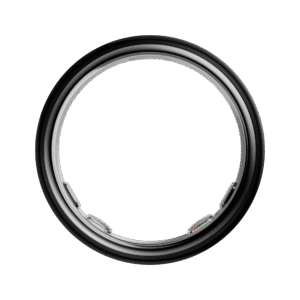

Oura began rolling out Health Radar, its set of blood pressure and breathing screens, to members in the European Union, the UK, Canada, Australia, New Zealand, Mexico and Saudi Arabia on October 6. GLP-1 Insights, a log for people taking GLP-1 medications, arrives in the same markets. Everything runs on any Oura Ring from Gen3 onward and needs an active membership, which costs £5.99 a month in the UK, €5.99 in the EU, CA$7.99 in Canada and A$9.99 in Australia. The ring itself never produces a blood pressure number. Oura’s help page says Blood Pressure Signals reads patterns in the ring’s overnight optical data and stays quiet unless it finds one worth flagging.
Blood Pressure Signals needs 15 nights before it says anything
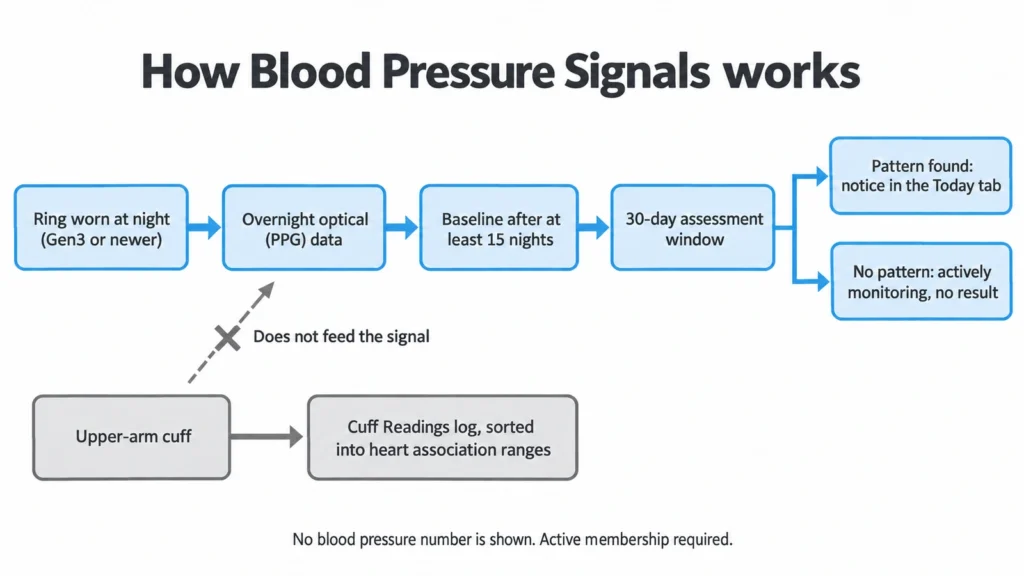
The feature works in 30-day assessment windows and needs at least 15 nights of data to build a baseline. Until it finds a pattern, the screen sits in an “actively monitoring” state with no result at all. A member who gets the update in its first week and sleeps in the ring every night will not have a baseline before the second half of October.
What it looks for is strain, measured through photoplethysmography, the optical pulse sensing the ring already uses for heart rate. Oura’s announcement describes the overnight dip as the signal that matters: blood pressure should fall during sleep, and when it does not fall consistently, that can point to cardiovascular risk that daytime readings miss. Nighttime BP is the screen that shows those dipping patterns over time.
Health Radar is tailored to the height, weight and sex at birth in your profile, so an old weight skews it. Turning Blood Pressure Signals off hides its past data and restarts the 30-day window when you turn it back on. And it switches itself off for anyone using Pregnancy Insights.
A flagged pattern can also cap the Heart Health rating in the app’s My Health tab, so a lower rating there may come from Health Radar, not from your workouts.
Cuff readings sit beside the trend
Cuff Readings lets you type in readings from an arm cuff, or import them from Apple Health or Health Connect on Android, and the app sorts each one into the American Heart Association’s ranges. Oura’s help page is specific that these readings do not feed Blood Pressure Signals, Nighttime BP or any Oura score. Advisor, the app’s chat assistant, can see them as context.
Circular’s Ring 2 works the other way round. It asks for three readings from a validated cuff to anchor its model, then shows an estimate in millimeters of mercury. On an Oura ring, the cuff remains the only source of an actual number, and Oura recommends a validated upper-arm model.
Nighttime Breathing and GLP-1 Insights
Nighttime Breathing gives a 30-day view of breathing disturbances during sleep. After seven nights it shows your prevailing pattern on a four-step scale from steady to highly varied, and at the end of each window it posts a notice in the Today tab if several nights looked varied. It sits in the Sleep detail screen.
GLP-1 Insights collects dose schedules, side effects and weight next to the ring’s sleep, activity, readiness and stress data. Oura says it does not recommend dosage changes, and the whole Health Radar suite is labeled for general wellness, not diagnosis.
Two US partners stay behind
In the US, a flagged Blood Pressure Signals result can open Counsel Health, an AI-assisted medical service in Oura Labs with licensed physicians behind it. US members whose breathing pattern is flagged may be pointed to ResMed for a sleep assessment. Oura’s help page marks both partners as US only. Outside the US the same result ends with the app’s advice to talk to a healthcare professional, with no booking route inside the app.
Ten languages and a missing country
Oura’s help page lists ten languages for Health Radar: Danish, Dutch, English, Finnish, French, German, Italian, Norwegian, Spanish and Swedish. Members in Poland, Portugal, Romania, Greece or Czechia will read the features in one of those, and Mexico gets Spanish. Saudi Arabia has no Arabic option.
The May 28 post that introduced Health Radar promised the October expansion to South Korea along with the other markets. On October 6 the announcement left South Korea out, while the help page, updated the same day, still lists it as rolling out. That help page also shows India and the United Arab Emirates already live, though neither appears in the announcement. Oura has not said whether Korean members are on a later schedule.