Samsung’s smart glasses passed US radio certification on 27 September 2026, in two models filed under FCC IDs A3LSMO200J and A3LSMO200P. The grants list Bluetooth and Wi-Fi 6E, and no mobile network radio. So the glasses Samsung showed with Gentle Monster and Warby Parker in July will reach the internet through your phone or a Wi-Fi network. Certification is the last regulatory step before they can be sold in the US. Samsung has still not given a price, a date or a list of countries.
Two frames in the filing
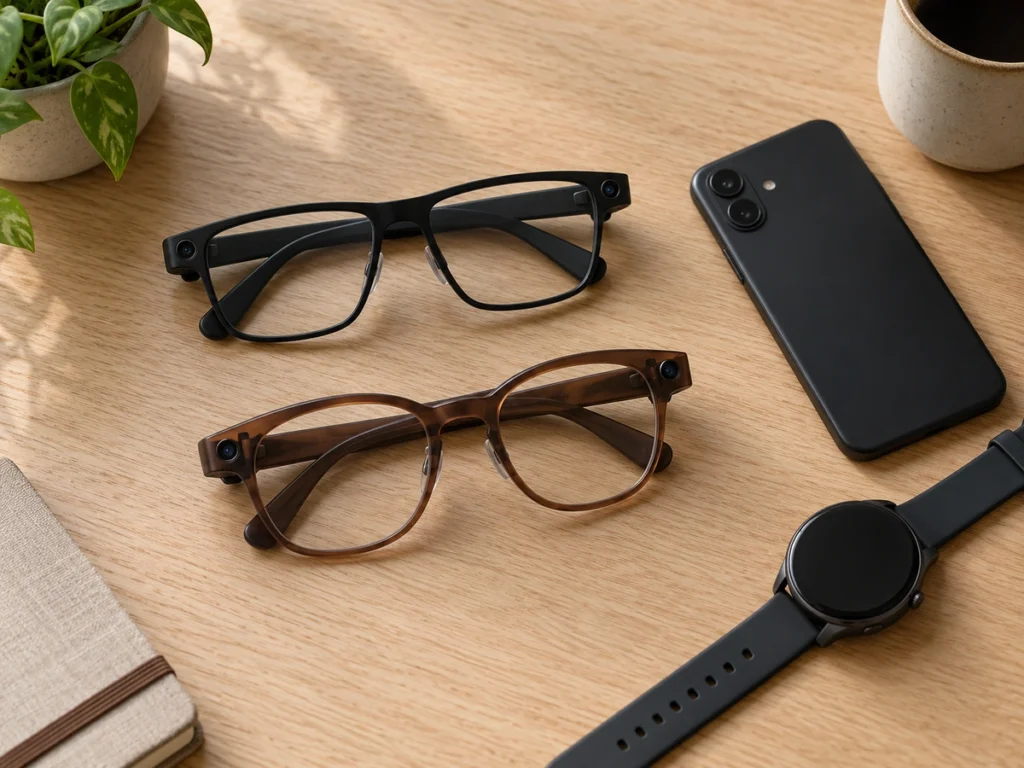
Both applications are dated 22 July 2026, the day Samsung introduced the eyewear at Galaxy Unpacked in London. Each is described as “Smart Glasses” and each was tested by the same lab, Element Materials Technology. That matches the two designs from July, a slim black Gentle Monster frame and a brown Warby Parker frame with an upswept brow. Samsung has not said which model number belongs to which brand.
The July announcement fills in the rest. The glasses have a built-in camera, run on Qualcomm’s Snapdragon AR1 Gen 1 chip and use Google’s Android XR platform with Gemini. Samsung rates them at up to nine hours per charge, with up to seven more full charges from the case. It never says whether either frame has a display.
What the radios say about daily use
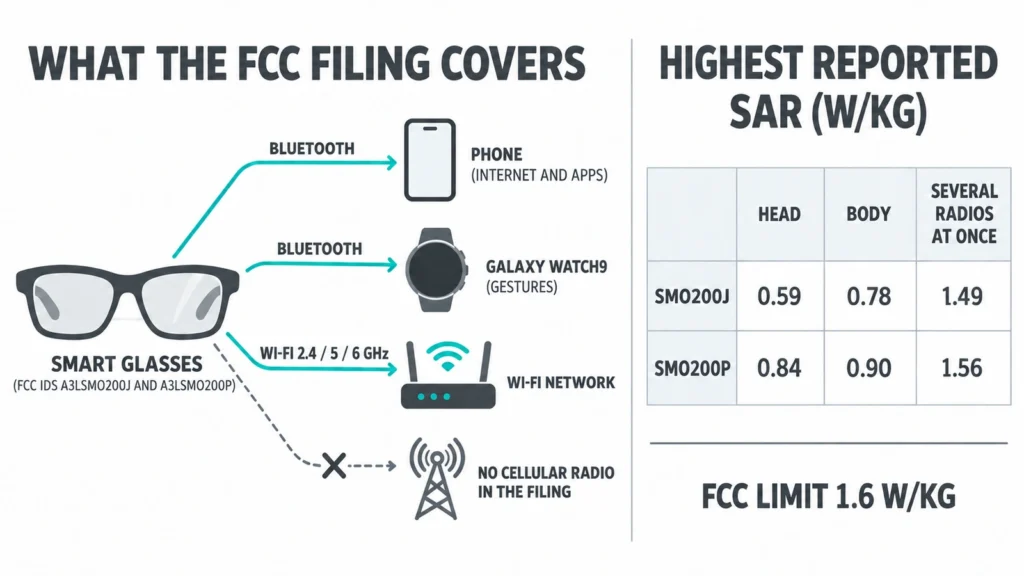
The grants cover Bluetooth Classic and Bluetooth LE, 2.4 GHz and 5 GHz Wi-Fi, and Wi-Fi 6E on the 6 GHz band. On that band they are certified twice, as a low power indoor client and as a very low power device. The second is the FCC class for small portable gadgets that may also use the band outdoors, at much lower power.
None of the grants covers a cellular band. On a walk or in a car, every Gemini answer, translation and route has to travel through the phone in your pocket.
Samsung’s own footnotes point the same way. Features “may require a network connection, compatible Galaxy device or supported app”, and gesture control is “only provided through Watch9”. A buyer without a Galaxy Watch9 gets voice and touch. Samsung has not said whether the glasses pair with an iPhone or with Android phones from other makers.
Radio exposure, close to the head
Glasses sit on the head all day, so the exposure figures in the grants deserve a look. The FCC limit for the head and body is 1.6 W/kg, averaged over one gram of tissue. Head values were taken in the normal wearing position and body values at 5 mm.
| Model | Highest head SAR | Highest body SAR | Several radios at once |
|---|---|---|---|
| SMO200J | 0.59 W/kg | 0.78 W/kg | 1.49 W/kg |
| SMO200P | 0.84 W/kg | 0.90 W/kg | 1.56 W/kg |
The single-radio results sit at about half the limit or less. The last column comes much closer, at up to 98 percent of it. That figure covers several radios transmitting together, and labs usually reach it by adding up each radio’s worst case, which overstates what happens in normal use. Both models pass. The P model simply has less headroom, and the filing does not say whether Samsung turns transmit power down when the glasses sense your head.
The March 2027 date is not a launch
The manual, the internal and external photos and the test set-up pictures are held back until 26 March 2027. That is a short-term confidentiality request, which keeps the documents private for up to 180 days. Makers usually publish them sooner, when the product goes on sale. Google’s Sameer Samat said in July that the companies want to bring the glasses “to people soon”, without a month.
Camera glasses also carry rules of their own. Samsung’s footnote says live visual sharing and recording “may vary by app, service, market and applicable laws or consent requirements”. In the Netherlands, the data protection authority has already said that filming other people with smart glasses is almost always unlawful, so the recording features may look different there than in the US.
Still unanswered
- The price of each frame, and whether prescription lenses cost extra.
- Which countries get the glasses first.
- Whether they work with iPhones and non-Samsung Android phones.
- Whether either frame has a display.
- Whether any Gemini features need a paid plan.
Until Samsung fills in the first two lines, Meta’s frames remain the priced benchmark, and our piece on the camera-free Ray-Ban Meta Audio sets out what a Gen 2 costs.